CHAPTERS: One | Two | Three | Four | Five
Recap of Chapter Four
The chapter opens with Frank surveying the threat of the river’s surge from the city’s outer barriers. The nearby Faraday nuclear plant, which is vulnerable upstream, increases the threat of the flood.
Frank receives a call from Mayor Wendell Hobbs, who seeks his expertise in handling the situation. Despite their conversation being cut short due to an emergency call from the Faraday plant, Frank understands the gravity of the situation and decides to assess the nearby dam himself.
The dam, a once proud feat of engineering, now shows signs of strain under the relentless force of the water. Frank’s visit to the dam’s operations center leads to a reunion with Sam Hartley, an old colleague. Their exchange reveals the dam’s critical condition and the potential catastrophic consequences of its failure.
The chapter ends with this chilling scene:
Frank’s phone vibrates with Sam’s name. Before he answers, a deafening crack drowns the tower’s chimes, the horizon blazing in an eerie glow.
His heart races, fearing the dam has failed. “Sam?” he screams into the phone.
But the line is dead. In the chilling silence that follows, Frank braces for the impending catastrophe.
Chapter Five: Bracing for Impact
“Nothing is too wonderful to be true if it be consistent with the laws of nature.”
Michael Faraday
“Mayor, the dam has failed. We’re not just dealing with a flood anymore,” Frank says, holding the wet phone away from his ear slightly.
On the other end of the line, Mayor Wendell Hobbs’ response is filled with disbelief. “Are you certain, Frank? This could mean…”
“I’m at the Faraday Nuclear Plant now, and the situation is bad. The plant may not withstand a deluge of this magnitude,” Frank interjects, his years of experience lending authority to his words. “We need to brace for the impact.”
The city has been evacuated. What else can we do? ” Hobbs asks, resignation seeping into his voice.
“I need to make some unpleasant but necessary calls,” Frank answers after an unsettling silence.
Hanging up, Frank turns to face the team in the control room, their faces reflecting a mix of fear and determination. His calm demeanor belies the adrenaline coursing through his veins. He pauses for a moment, surveying the majesty of the technology—the achievement of human engineering. Reaching inside his rain-soaked shirt, he squeezes the cross pendant he has worn since that night—the night he lost everything but found a new purpose—his son.
In the bustling control room, Frank dials the Nuclear Regulatory Commission (NRC), the crucial federal link in the crisis.
“This is Frank Johnson at Faraday. We’re facing a critical situation.”
The voice on the other end is calm and professional, offering a stark contrast to the tense atmosphere enveloping Frank. “This is Greg Saunders at the NRC Operations Center. What’s your status, Mr. Johnson?”
“We’ve got potential flooding due to the upstream dam failure. Our reactor cooling systems are at risk. Emergency protocols are being initiated, but we’re on the brink of escalation.”
After a moment of contemplation, Saunders responds. “Understood, Mr. Johnson. We’re mobilizing our emergency response team now. Keep us updated on every development. Start your emergency shutdown procedures immediately and follow all safety protocols without deviation.”
Ending the call, Frank turns to face Supervisor Richard Daley, his gaze conveying the gravity of their predicament. “We’ve got NRC support. Let’s move fast. Initiate the controlled shutdown and reinforce all barriers. Time is not on our side.”
Daley nods, the weight of responsibility evident in his expression. “Understood. I’ll get the teams moving. The water’s approaching fast. Our pumping stations will give us some time, but with this volume of water…”
Checking the river water level monitors, Daley wipes away the perspiration that has begun to burn his eyes. The now 2-hour-old coffee he’s been nursing shows tiny ripples on the surface as he raises his uncharacteristically nervous hand to take the final sip.
“This plant was constructed with cutting-edge safety systems, specifically engineered to withstand extreme conditions, including significant flood events,” Frank says assertively, cutting through the rising tension. “Look around you—each one of you is an expert in your field, the best of the best. Together, we’ve handled crises before and emerged stronger. Given our collective skills and the robustness of our systems, I firmly believe we stand a good chance.”
As Frank’s words resonate through the room, a feeling of determined resolve spreads among the team members. Jenkins, a veteran engineer, nods firmly, his expression turning from worry to one of focused commitment. Beside him, Dr. Patel, the plant’s chief physicist, glances up from her console, a newfound steadiness in her eyes. The team exchanges expressions of quiet agreement as Frank’s assurances rekindle their sense of unity.
In the midst of the chaos, Frank’s presence is a grounding force. His posture, upright and unwavering, conveys a sense of control amidst the uncontrollable. Yet, even he can’t mask the flicker of uncertainty in his eyes, a subtle but unmistakable sign of his humanity. His gaze occasionally drifts toward the window, where the dark, churning skies mirror the turmoil inside him.

As the team at Faraday prepares for the imminent threat of the flood, the scene shifts to a living room outside the city. The glow of the TV illuminates anxious faces; neighbors huddled together, reflecting the community’s tension. On the screen, a news anchor relays the latest updates from the Faraday nuclear facility.
Mrs. Thompson, a middle-aged woman with a worried expression, breaks the silence. “Frank’s always been about protecting this city. What happened at the Green Frog was tragic, but he acted to save others.”
Mr. Henderson, leaning against the doorframe with crossed arms, counters, “But taking a life, especially his own brother’s? Puts a big question mark on his role now.”
Their words capture the duality of opinions swirling through the room: respect for Frank’s dedication mingled with unease over his past actions. As the TV shows Frank at Faraday, determination visible on his face, the room falls silent. In that moment, Frank is more than a sheriff; he is the last line of defense against an impending disaster. The community’s mixed feelings about him hang in the air, unresolved.
As the TV continues to broadcast updates, the residents’ debate reflects the wider community’s anxiety and divided opinions about Frank Johnson. While some see him as a figure of resilience, others can’t shake off the shadows of his past. The screen shows the relentless rain outside, a visual reminder of the looming crisis that extends far beyond their homes.
The rain lashes against the windows of City Hall, where a different kind of storm is brewing. Mayor Wendell Hobbs, along with city officials and emergency responders, are preparing for a critical meeting.
The gravity of the situation at Faraday has pulled together a formidable assembly, including representatives from the NRC and the Federal Emergency Management Agency (FEMA). They are here to strategize and coordinate a response to a crisis that is rapidly escalating beyond the city’s borders, affecting not just the residents watching from their homes but the entire region.
In the meeting inside the emergency operations center, Mayor Wendell Hobbs quickly sets the tone. “We’re at a critical juncture with Faraday. The NRC and FEMA are with us. Let’s focus on our immediate steps.”
Susan Clark from the NRC and David Gomez from FEMA give brief but firm updates on their agencies’ roles, emphasizing the severity of the situation and their commitment to public safety.
The conversation swiftly shifts to Sheriff Frank Johnson’s involvement. Councilwoman Alice Carpenter, her voice tinged with concern, gets straight to the point. “Frank’s past actions, especially at the Green Frog, cast a shadow on this decision. How can we justify this risk?”
Fire Chief Collins adds succinctly, “Public trust is key. Frank’s capabilities are undeniable, but his presence could be divisive.”
Councilman Willie Arnold, looking directly at the mayor, interjects with a note of urgency. “Frank’s expertise with Faraday’s protocols is unparalleled. This isn’t about the past; it’s about addressing the crisis at hand.”
The debate is brisk and charged, reflecting the community’s mixed sentiments. Mayor Hobbs acknowledges the concerns but affirms the current course of action. “We proceed as planned. Frank’s role, given the circumstances, is necessary. Our priority is the safety of our citizens.”
As the meeting adjourns, the weight of the crisis and the unresolved feelings about Frank’s role linger in the air, echoing the complexity of the challenges ahead.
Back in the control room at Faraday, the team members work diligently on the emergency shutdown procedures, racing against time and the relentless approach of the floodwaters.
Supervisor Daley turns to Frank, his face marked with concern. “The core’s cooling too slowly. We might not stabilize it before the water hits.”
Frank’s gaze hardens. He knows what is at stake—not just the facility, but the entire city. “Keep pushing the cooling systems. We have to buy more time.”
Outside, the floodwaters charge toward the facility like a relentless beast. The once-calm, meandering river has transformed into a raging torrent, carrying with it the force of nature’s fury.
Frank’s phone suddenly vibrates against the console. He glances at the caller ID—it’s Susan Clark from the NRC. The urgency in her voice is immediate. “Frank, the President has been briefed, and you have full federal support. Additional resources are on standby.”
Frank’s hand tightens around the phone. “Understood, Susan. We’re doing everything we can here.”
As he hangs up, the gravity of the situation settles over him. The President’s involvement signals the crisis’s escalation to a national emergency. He looks around the room at his team, their faces a mix of determination and apprehension, aware that the next few moments are critical.
Just then, the room shudders. A low groan echos through the walls as the emergency lights cast a red glow over the team. The sound of water crashing against the barriers thunders in their ears.
“Frank, what’s our next move?” Daley’s voice cuts through the din.
Before Frank can respond, the control room plunges into darkness, the emergency lights flickering ominously. Outside, the floodwaters bear down on Faraday, their fury now at the doorstep.
Author’s Notes:
Michael Faraday (1791–1867) was a profoundly influential English scientist known for his groundbreaking work in the field of electromagnetism and electrochemistry. Born in humble beginnings to a blacksmith, Faraday received minimal formal education. However, his insatiable curiosity and self-education led him to become one of the most celebrated and influential scientists of the 19th century.
In the United States, the primary government agencies that would be involved in dealing with a nuclear crisis are the Nuclear Regulatory Commission (NRC) and the Federal Emergency Management Agency (FEMA). Each agency has distinct roles and responsibilities in such a situation.
Actual people, places, and events served as inspiration for some of the story’s elements.
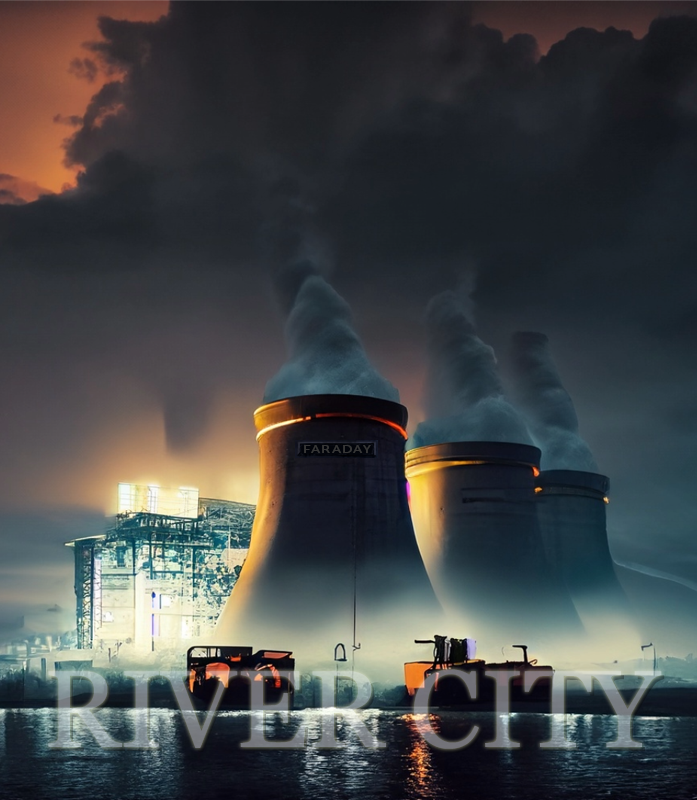
Cover Image: © Jamison Brown
Frank could be in a conflict with the company owning the plant or their rep over possible damage to the plant, due to rapid cooling, or something else, versus peoples lives. Quick decisions have to be made and not everyone will be happy. Profits or do the right thing for puplic safety? Also who is to blame. The public will need someone to blame.
Your writing has me waiting in suspense for your next chapter.
They’re likely to blame Frank. We will see.
Waiting expectantly on chapter 6. The chapters read quickly and with the urgency of the situation.
Intense, nerve-wracking, surreal…and yet we know such a crisis can be moments away in any number of Nuclear Facilities worldwide. Frank’s character creates the fictional “rub” between scientific judgment and the innate need for each of us to try to save our own. You left us at a critical point. I’ll be looking for the next installment!
Many thanks, K.
Frank has some big problems. It must be especially tough when you don’t have the support of the people you are trying to save. Will he grow tired of the criticism?
No. He is the hero. He may be tempted but he is the good guy not the villain.
We will see…