
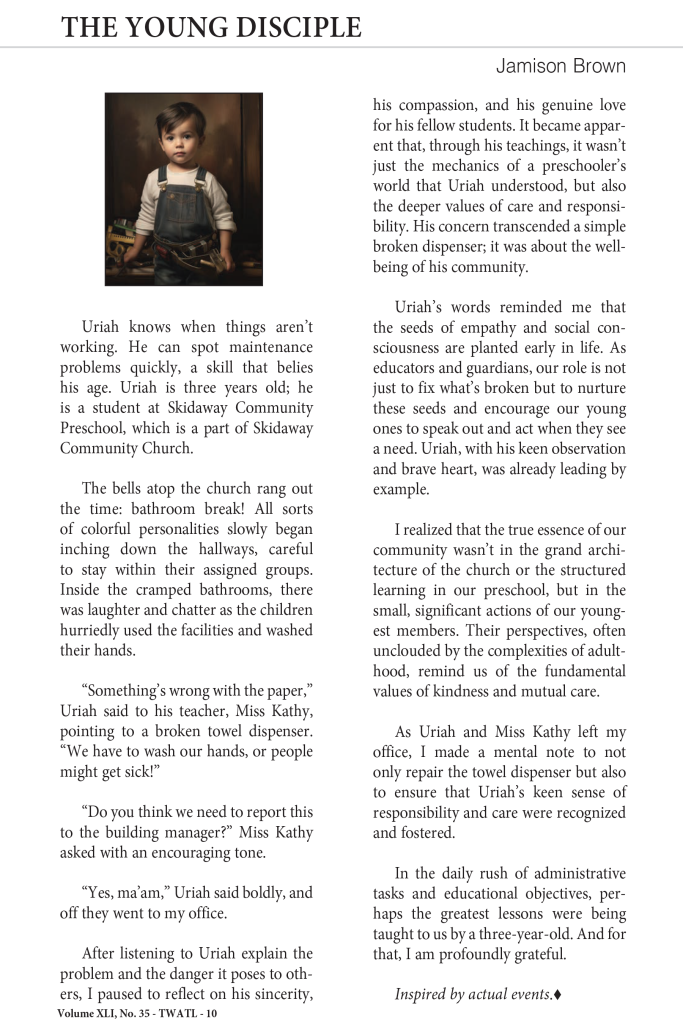
Uriah knows when things aren’t working. He can spot maintenance problems quickly, a skill that belies his age. Uriah is three years old; he is a student at the community preschool, which is a part of the community church.
The bells atop the church rang out the time: bathroom break! All sorts of colorful personalities slowly began inching down the hallways, careful to stay within their assigned groups. Inside the cramped bathrooms, there was laughter and chatter as the children hurriedly used the facilities and washed their hands.
“Something’s wrong with the paper,” Uriah said to his teacher, Miss Kathy, pointing to a broken towel dispenser. “We have to wash our hands, or people might get sick!”
“Do you think we need to report this to the building manager?” Miss Kathy asked with an encouraging tone.
“Yes, ma’am,” Uriah said boldly, and off they went to my office.
After listening to Uriah explain the problem and the danger it poses to others, I paused to reflect on his sincerity, his compassion, and his genuine love for his fellow students. It became apparent that, through his teachings, it wasn’t just the mechanics of a preschooler’s world that Uriah understood, but also the deeper values of care and responsibility. His concern transcended a simple broken dispenser; it was about the well-being of his community.
Uriah’s words reminded me that the seeds of empathy and social consciousness are planted early in life. As educators and guardians, our role is not just to fix what’s broken but to nurture these seeds and encourage our young ones to speak out and act when they see a need. Uriah, with his keen observation and brave heart, was already leading by example.
I realized that the true essence of our community wasn’t in the grand architecture of the church or the structured learning in our preschool, but in the small, significant actions of our youngest members. Their perspectives, often unclouded by the complexities of adulthood, remind us of the fundamental values of kindness and mutual care.
As Uriah and Miss Kathy left my office, I made a mental note to not only repair the towel dispenser but also to ensure that Uriah’s keen sense of responsibility and care were recognized and fostered.
In the daily rush of administrative tasks and educational objectives, perhaps the greatest lessons were being taught to us by a three-year-old. And for that, I am profoundly grateful.
Inspired by actual events.
18 At that time the disciples came to Jesus and asked, “Who, then, is the greatest in the kingdom of heaven?” 2 He called a little child to him, and placed the child among them. 3 And he said: “Truly I tell you, unless you change and become like little children, you will never enter the kingdom of heaven. 4 Therefore, whoever takes the lowly position of this child is the greatest in the kingdom of heaven. 5 And whoever welcomes one such child in my name welcomes me.”
Matthew 18:1–5
Published: Building Bridges, Skidaway Community Church, February 2024.
Published: TWATL magazine, March 2024.
Published: The Skinnie Magazine, May 2024.


And just when we think they’re not paying attention…. Such sweet compassion from a little fellow. Thank you Jim for sharing
It was indeed an inspiring and encouraging conversation, Robin. There is hope to be found in our youth—if we look for it.
Thanks for your kind words.
Beautiful story and very meaningful! We just have to listen to all the words!
Many thanks, Judy. I’m so glad you enjoyed this, and it’s great to hear from you!
Uriah saw a small need, but had a larger picture of that need.
It will not be easy to be as a child again..
I do remember an elderly woman that would light up when she met a child. She loved every child and it showed. She is gone now but I think she was as close to being a child as I have ever met.
Thanks for reading this, Wes.
A most beautiful story, so simple, yet so complex. Send this to the ‘upper room’ magazine for publication.
Thanks, Jane.
Love that story. It is so true and we need to listen to our little ones.
Thanks, El. There is hope—if we listen.