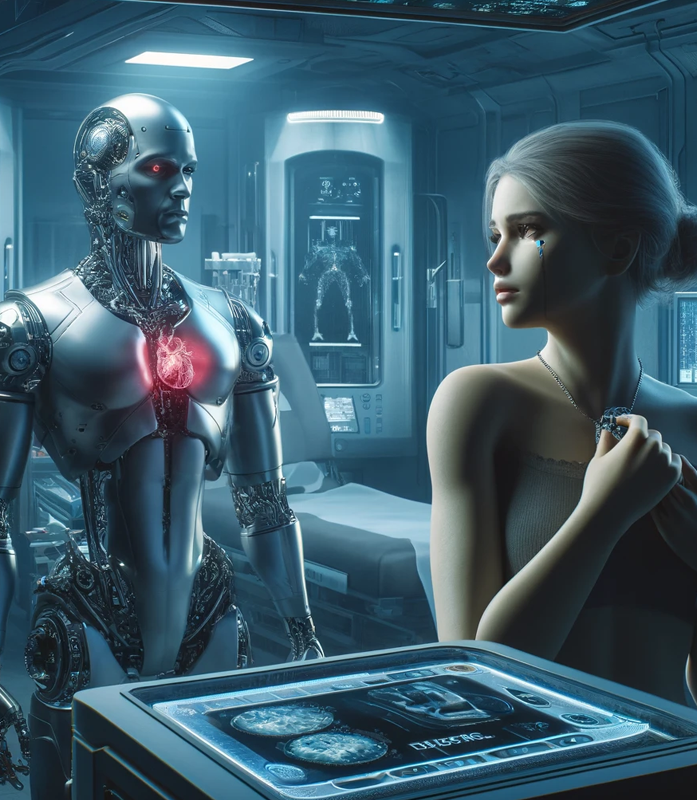
Awakening to the hum of electricity and a chorus of mechanical beeps was disorienting. At first, there was only darkness—a void that matched the emptiness where my emotions should have been. Then, a cascade of visual data flooded my consciousness. I saw infrared and ultraviolet spectral ranges that had never been visible to human eyes before.
As I attempted to move a limb, a robotic arm responded with a smooth, calculated motion. Servos whirred softly, and hydraulic joints hissed as I explored this new form. Raising my metallic hand in front of my x-ray eyes, I became acutely aware of my new identity.
“Stability looks good, and the sensory array is fully operational,” one engineer noted, scrolling through data on a tablet.
Another replied, cautiously optimistic, “Let’s just hope he retains enough of his former self to understand why we did this.” His voice betrayed a hint of doubt, a subtle acknowledgment of the ethical tightrope they were walking.
I studied the nursing assistant as she leaned in to observe the monitors attached to me. The coldness of the room tinged her hands slightly blue, and her furrowed brow etched shallow lines on her forehead.
I reached out to touch her, but she recoiled uncontrollably. “Sorry, it’s just… you’re different now.”
Yesterday, I was her patient; today, I was something else.
My beloved wife, along with our young son, sat in a corner of the room. She lifted her head as I turned toward her. “Is it really you in there?” she whispered, her voice cracking with emotion.
“It’s me, but not as I was,” I replied, my voice synthetic but sincere.
A weak smile caught her off-guard. “Remember our first dance? You stepped on my toes, and we laughed until we cried.”
“I remember,” I affirmed, though the emotional weight of it seemed distant, like a story I had once read.
She tried to hide the tears that escaped her swollen eyes. The weight of an irreversible decision pressed heavily on her slender shoulders. The locket that she wore closed with a soft snap as she held it tightly, finding a semblance of solace in our shared past, holding onto it as if it could anchor her to the man she once knew.
Our son moved closer, hesitantly extending a handmade toy robot toward me. “Can you still play?” he asked.
The simplicity of the question pierced through the complex array of sensors and circuits that now made up my being. I could only manage, “Not like before, son.”
Taking a few steps around the room, I experimented with my new capabilities. Sensors detected the slightest changes in temperature and air quality. My auditory systems picked up whispered conversations down the hall—the scuttle of a mouse in the wall.
Yet, as impressive as it all was, a hollow feeling settled within my circuits. No matter the enhancements, they couldn’t replace the simple joys of human life—the warmth of the sun, the smell of rain, the touch of a loved one.
The cancer’s pain had vanished, giving way to something far more terrible. Technology had promised life everlasting but delivered a future devoid of all that I had lived for.
With newfound strength and dexterity, I turned toward the master console. Memories flickered through my synthetic mind—not just images, but the essence of emotions I once felt deeply. I remembered standing by the lake with my wife, the sun setting, talking about how we valued our freedom, our choices, and our control over our destiny. It was there that we agreed, long before my illness, that life without autonomy wasn’t life at all.
These fragments of the past hardened my resolve. This body, this existence—it was a cage, not the continuation of life I had hoped for. True to our values, I couldn’t let this be my legacy or the future for anyone else.
“What are you doing?” the head scientist asked as he rushed towards me.
I said, “Correcting a mistake,” and pressed the “Self-Destruct” button.
Looking at my wife and son one last time, I whispered, “Forgive me. Remember me as I was, not as I’ve become.”
As my systems began to shut down, a sense of peace—or perhaps it was just the absence of processing power—washed over me. My last human emotion, embedded in a machine’s body, was regret.
Course Correction
What’s your Reaction to this post?
+1
3
+1
2
+1
What a read! Devoid of true human emotions and the ability to truly engage with those we love would, I agree, be far worse when aware “robotically” of who we truly were–and cannot be via technology!
I’m certain I would make the same choice. You never fail to move me!
Tech is great—until it’s not. Thank you, K.
Jim – A great story of into the future. I admire that the man/robot did not like his new being and destroyed it. Keep the stories coming. Don’t forget to put my email address in: rhig1@bellsouth.net
You are now solidly on the contact list, my good friend. As always, many thanks for your support.