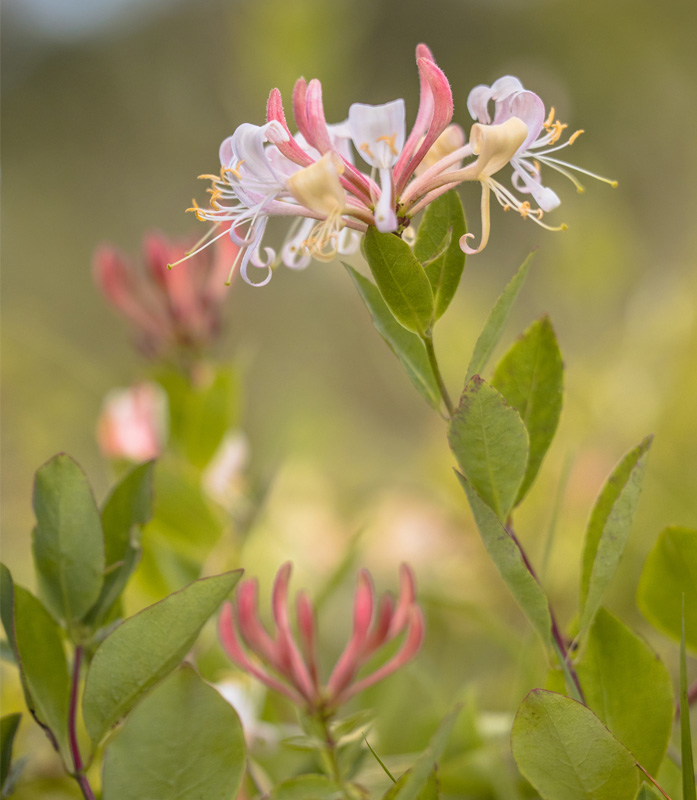
honeysuckle blooms
gently waft on summer breeze ~
lullaby in air
Author’s Notes:
Traditional and structured, this short form of Japanese poetry is well-known for its rule of 5/7/5: five syllables in the first line, seven in the second, and five again in the third. Haikus are known for their ability to paint a vivid picture in just a few words.
The three lines of the poem do not rhyme and they typically avoid metaphor, simile, and exposition in favor of imagery and contrast. Traditional examples center around nature and/or the seasons and aim to capture a simple moment in time.
Honeysuckle is the general, common name for about 200 species of deciduous, semi-evergreen flowering vines and shrubs. In addition to producing sweet-smelling, trumpet-shaped flowers that range in color from white to yellow to bright orange, red and pink, honeysuckle plants also produce black, red or blue berries.
Sometimes referred to as woodbine, has also been frequently mentioned in classic British literature. Both William Shakespeare and Geoffrey Chaucer refer to the honeysuckle plant in “Twelfth Night,” “A Midsummer Night’s Dream” and “The Canterbury Tales.”