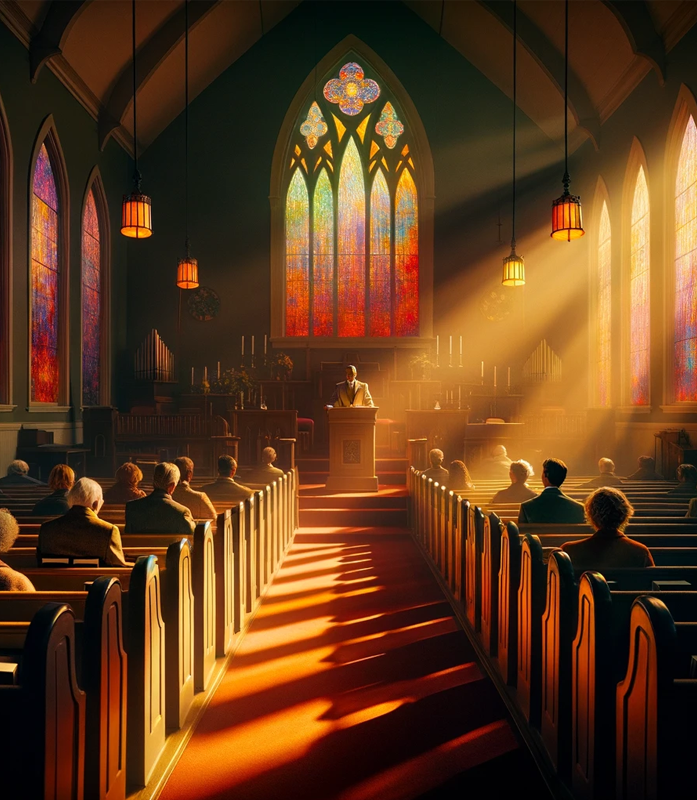
The stained-glass windows painted the interior of the church with a kaleidoscope of colors one Sunday morning, casting an ethereal glow on the congregation gathered within. However, despite the beauty of the setting, there was an unusual dynamic at play. The pews at the back of the church were filled, while the ones at the front remained conspicuously empty.
Reverend Waylon Hall, a man known for his impassioned sermons and deep, resonant voice, stood at the pulpit with an air of concern. Today, his voice was not its usual powerful self; a lingering cold had reduced it to a weak echo of its former strength. Yet his spirit was undeterred as he began his sermon, a message he hoped would stir the souls of his flock.
As Hall spoke, his words seemed to struggle to reach the back of the church, where his congregation sat comfortably ensconced in their habitual spots. Despite his efforts, the message seemed to fall short, lost in the vast gulf between him and his listeners.
It was then that a man from the back pew stood up, a hint of frustration in his voice as he called out, “Reverend, can you speak up? We can’t hear you back here!”
With a mix of determination and dismay, Hall paused, his brow furrowing as he surveyed the palpable distance—physical and emotional—between him and his congregation. In a respectful yet firm tone, he replied, “Perhaps if you find my voice too soft, you might come closer. There’s plenty of room at the front.”
The man hesitated, his glance darting to the empty pews before him, then back to his familiar spot. With a shrug, he settled back down, a murmur of agreement rippling through the others. “I’m comfortable where I am,” he said, his words reflecting the sentiment of many around him.
The congregation shifted uncomfortably, growing uneasy as they exchanged glances, contemplating the reverend’s invitation and their own resistance. A sense of reflection stirred among them, their comfort contrasting with the beckoning empty pews at the front.
Across the aisle, Mary whispered, “It’s challenging, isn’t it? To move when it’s uncomfortable. But maybe that’s what we need—instead of just waiting for the sound to reach us.”
Her companion, a middle-aged man, nodded in agreement but added, “Change is hard at our age. It’s not just about moving seats; it’s about shifting mindsets.”
Nearby, a teenager whispered excitedly to her friend, “Imagine if we actually did sit at the front next week! It’d be a real shock, wouldn’t it?”
As the sermon concluded, the physical distance of the parishioners from the pulpit paralleled the spiritual message Hall sought to impart: “If you are comfortable in life, you likely are not progressing.”
It was a call to action, a plea for the reverend’s flock to fight complacency. Complacency is the enemy of growth and progress. Complacency can feel comfortable, but it’s a temporary comfort.
The church emptied slowly, the message lingering in the air. For some, it was a moment of reflection. For others, the day’s sermon would be a topic of discussion, perhaps a spark for change. The scene during the sermon was a reminder that true progress requires effort, discomfort, and the willingness to leave behind the familiar for the unknowable promise of something greater.
In the quiet of the now-empty church, Hall pondered the small yet significant steps that could bridge the gap between comfort and growth. He imagined his flock embracing opportunities that stretched their boundaries: volunteering for a cause that challenged their worldview; learning a new skill that seemed daunting at first; reaching out to mend a strained relationship; or even choosing to sit at the front.
As he stepped down from the pulpit, his resolve was clear. Next Sunday, he would repeat his call to action, while committing to leading by example, sharing his own uncomfortable steps. He would address topics that were often avoided—those uncomfortable steps that need light shed upon them, even if it meant facing criticism or dissent.
It was a starting point for a collective journey towards growth, understanding, and a deeper engagement with life’s boundless opportunities.
“Not that I have already obtained all this, or have already arrived at my goal, but I press on to take hold of that for which Christ Jesus took hold of me. Brothers and sisters, I do not consider myself yet to have taken hold of it. But one thing I do: Forgetting what is behind and straining toward what is ahead, I press on toward the goal to win the prize for which God has called me heavenward in Christ Jesus.”
Philippians 3:12-14
The gap between where we are and a more meaningful relationship to our Savior grows smaller with each baby step.
Perhaps we stand apart because we feel we are unworthy.
Perhaps we are, indeed, mired in complacency.
As we reach out out to one in need, God smiles.
He is calling us closer!
This piece is beautifully written, capturing both the physical and spiritual dynamics within the church setting with vivid detail. The use of symbolism and metaphor effectively conveys the message of stepping out of one’s comfort zone for personal and spiritual growth. Well done!
Thanks, Eleanor.
Love this one. No trouble in view for you, just beautiful words.
Thanks for your kindness, Jane.